
 By IB Electric

- An electrical permit in Michigan is required before installing, altering, or adding to wiring, including new circuits, panels, EV chargers, and generators.
- Homeowners may pull their own permit, but only for work they personally do in a single-family home they own and occupy.
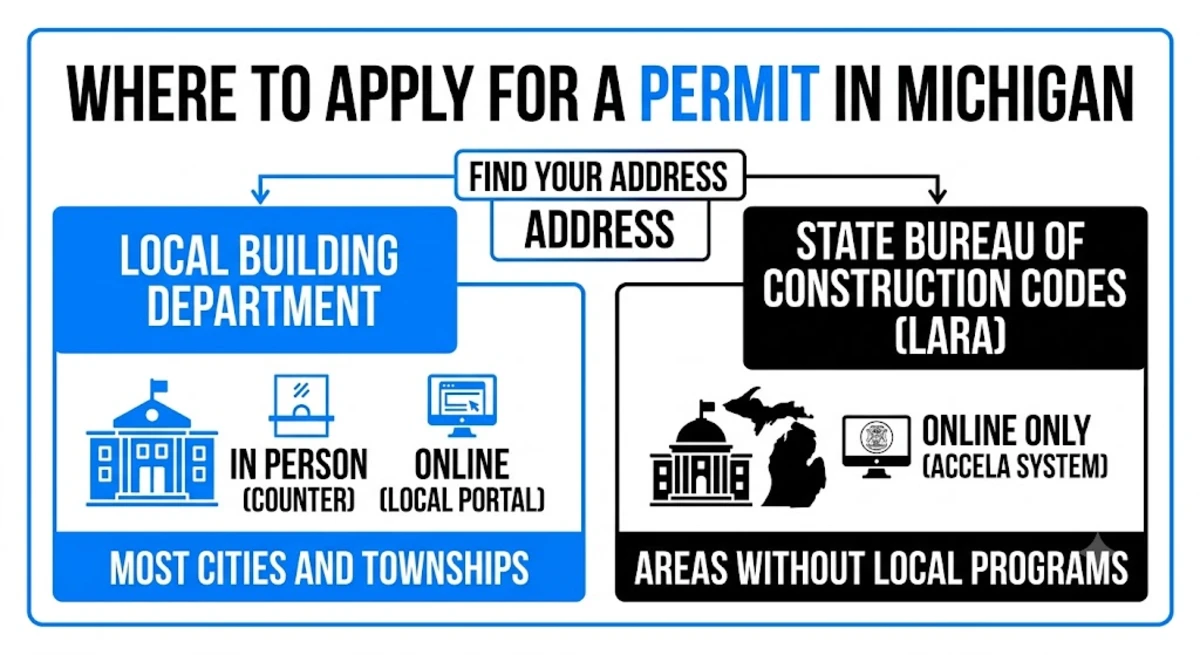
- Most cities and townships issue their own permits; the state Bureau of Construction Codes covers areas without a local program.
- Fees are set locally, and a typical single-family electrical permit runs roughly $75 to $300 depending on the job.
- Rough wiring must be inspected before it is covered, and state inspectors typically inspect within five business days of a request.
An electrical permit in Michigan is required before anyone installs, alters, or adds to a home’s wiring. That covers new circuits, panel upgrades, EV chargers, generators, and rewiring. A licensed contractor usually pulls it. Homeowners may pull their own, but only for work they do themselves in the single-family home they live in.
IB Electric has pulled electrical permits across Wayne, Oakland, and Macomb counties since 2002. Our founder, Imad Boussi, has been a Michigan master electrician since 1997. Permits cause more confused calls than any other part of a job. Owners hear mixed advice about who can pull one, where to file, and what it costs. This guide answers each question in turn, and it links to our job-specific guides for panels, generators, and EV chargers.
When Do You Need an Electrical Permit in Michigan?
You need an electrical permit in Michigan any time you install, alter, or add to a building’s wiring or electrical equipment. In a home, that means new circuits, outlets, and fixture spots, panel and service upgrades, subpanels, EV chargers, generators, hot tubs, and rewiring. It also covers basement finishes and remodels that move or extend wiring. The rule applies whether a contractor or a qualifying homeowner does the work.
The gray zone is simple repair. Many local building departments treat a same-spot swap of a switch, outlet, or light as minor repair. With no new wiring, that often needs no permit. However, that is a local reading, not a statewide blanket exemption. The moment a job adds a device location, extends a circuit, or touches the panel, it needs a permit. When in doubt, a two-minute call to your building department settles it before any money is spent.
| Job | Permit needed? | Notes |
|---|---|---|
| Swap a switch, outlet, or fixture in the same spot | Often not | Confirm locally; many treat it as minor repair |
| Add an outlet, fixture location, or circuit | Yes | New wiring always needs a permit |
| Replace or upgrade a panel or service | Yes | Utility coordination required |
| Install a Level 2 EV charger | Yes | Adds a 240-volt circuit |
| Install a standby generator | Yes | Plus a mechanical or gas permit |
| Rewire rooms or the whole house | Yes | Rough inspection before walls close |
| Finish a basement | Yes | Often alongside a building permit |
Once you know a permit is needed, the next question is who can pull it.
Who Can Pull an Electrical Permit in Michigan?
Two groups can pull an electrical permit in Michigan: licensed contractors and some homeowners. A licensed contractor can pull permits for any property, and most homeowners go this route. The homeowner path is narrower. According to LARA, the exemption covers a homeowner performing wiring work in a single-family home and its outbuildings that are owned and occupied, or to be occupied, by the person doing the installation. State law places this exemption in MCL 339.5737(g).
Each part of that rule matters. The home must be single-family. You must own it and live there, or plan to. Most important, you must do the work yourself. The exemption does not cover rentals, commercial property, or a house you are flipping. It also does not excuse the inspection: inspectors hold a homeowner permit to the same code as a contractor’s. Detroit runs its own permitting and licensing process, so city residents should follow Detroit’s rules for homeowner permits.

The Homeowner Exemption Is About the Tools, Not the Deed
What most guides get wrong: they describe the homeowner exemption as a right that comes with owning the house. It is really about who does the work. Owning the home qualifies you to pull a permit only for your own labor. Hire a handyman, a friend, or an unlicensed relative, and the homeowner permit no longer fits. That person also cannot legally do permitted wiring work for you. Insurers and buyers can treat that arrangement as unlicensed work if something goes wrong. In short, the permit follows the person holding the tools. If you are not sure the exemption fits, ask the permit office before you start, not after.
How to Verify a Contractor Before They Pull It
Before a contractor pulls a permit for your home, confirm the license. The Bureau of Construction Codes offers a Verify a License lookup, which shows whether an electrical contractor’s license is active. Ask for the permit number before work starts, and make sure it appears on the job site. A good contractor also carries insurance and books the inspections without being asked. If a contractor suggests skipping the permit to save money, treat that as a reason to hire someone else. Also confirm the company name on the license matches the name on your contract, since the permit is tied to the licensed contractor.
With the right person lined up, the next step is knowing where to file.
Where Do You Apply: City, County, or State?
You apply to the permit office for your address, which the law calls the enforcing agency. It is usually your city or township building department. Most Metro Detroit towns run their own inspection programs and issue permits directly, at a counter or online. Some counties enforce the code for smaller townships. Where no local program exists, you need a State of Michigan electrical permit from the Bureau of Construction Codes, filed through its online permit system.
LARA suggests checking its Statewide Jurisdiction List first, because enforcement can shift between the state, a county, and a town. Filing with the wrong agency is a common cause of delays. Detroit is a special case, since the city runs its own permitting and licensing process separate from the state. According to LARA’s 2024 permit form, plans are not required when the electrical system is 400 amps or less and the building is 3,500 square feet or smaller. (LARA, 2024) That covers most single-family homes.
Pro tip: Search your city or township name with “building department electrical permit” before calling. Many Metro Detroit communities post their fee schedule, application, and inspection request line online.
Use the tool below to see what applies to your job, your installer, and your address.
Once you know where to file, the cost is usually the next question.
How Much Does an Electrical Permit Cost in Michigan?
Electrical permit fees in Michigan are set by each permit office, so the same job can cost different amounts in nearby towns. Most schedules combine a small filing fee, a base fee that includes an inspection, and per-item charges for services, circuits, and equipment. According to DeWitt Township’s 2026 fee schedule, a home electrical permit carries a $15 application fee and a $100 base fee covering one inspection. (DeWitt Township, 2026) Ann Arbor adds per-item fees, such as $7 per branch circuit under 208 volts.
Across the state, a typical single-family electrical permit runs roughly $75 to $300 depending on the job and the community. A single EV charger circuit in Metro Detroit often falls between $50 and $200, as our EV charger permit guide explains. Service upgrades, generators, and whole-house rewires cost more, since they carry more items and inspections. Contractors often fold the fee into the quote, so ask to see it listed as its own line.

| Fee type | Example | Source |
|---|---|---|
| Application fee | About $15 | DeWitt Township (2026); Ann Arbor |
| Base permit with one inspection | About $100 | DeWitt Township (2026) |
| Branch circuit, under 208 volts | About $7 each | Ann Arbor |
| Branch circuit, 208 volts and over | About $20 each | Ann Arbor |
| Typical single-family permit total | $75 – $300 | Michigan Electrical Authority |
| Single EV charger circuit, Metro Detroit | $50 – $200 | IB Electric EV permit guide |
Paying the fee starts the clock on inspections, which is where the permit does its real work.
What Happens at an Electrical Inspection?
A Michigan electrical inspector checks the work at least twice: once at rough-in and once at final. The rough inspection happens after cable is run and boxes are set, but before insulation or drywall covers anything. At that visit, the inspector checks wire sizes, box fill, grounding and bonding, cable support, and circuit protection. The final inspection happens once devices, fixtures, and panel work are complete, labeled, and energized where required. Panel and service jobs also clear the way for the utility to reconnect or upgrade the service.
Timing depends on the permit office. According to LARA’s 2024 permit form, a state inspector responds to an inspection request within two business days and typically inspects within five. (LARA, 2024) The same form says no work may be covered until it is inspected. A permit also stays valid while work moves forward and inspections are requested. Local departments often move faster. Our electrical panel upgrade permit guide covers what they look for on panel jobs.

- Confirm the enforcing agency. Find out whether your city, township, county, or the state issues electrical permits for your address.
- Apply for the permit. Submit the application with the job description, service size, and contractor license number, or a homeowner affidavit if you qualify.
- Pay the fees. Pay the application fee plus the inspection and item fees on your local schedule.
- Schedule the rough inspection. Call for inspection once wiring is run and boxes are set, before any insulation or drywall covers it.
- Pass the final inspection. Request the final once devices, fixtures, and panel work are complete and labeled.
- Close out with the utility. For service or panel work, the inspection approval lets DTE Energy or Consumers Energy restore or upgrade the connection.
Pro tip: Keep the final inspection approval with your house records. Buyers, home inspectors, and insurers often ask for it, and a copy saves a trip to the building department years later.
Want the permit handled for you?
IB Electric pulls the permit, books each inspection, and works with DTE Energy or Consumers Energy on service jobs across Metro Detroit. Book an assessment or explore our residential electrical services.
Not every house has a clean permit history, though, and that raises its own questions.
What If Electrical Work Was Done Without a Permit?
Unpermitted wiring work does not disappear; it waits for the worst moment to surface. The permit office can require an after-the-fact permit, an inspection, and fixes. Sometimes that means opening finished walls or ceilings so the inspector can see the wiring. Insurers may question a claim tied to unpermitted work. Home inspectors often flag it during a sale, too. Buyers and lenders often ask for permit records on panels, basements, and additions.
If you suspect a past owner skipped permits, start with the building department’s records for your address. A licensed electrician can then evaluate the work and permit any fixes, which turns an unknown into a documented fix. Older homes often carry more of these surprises, as our guide to old house electrical problems explains. The earlier you find them, the cheaper they are to fix. Above all, do not add new circuits onto unpermitted wiring, because that stacks new risk on top of an unknown.

The last piece is knowing which code edition your inspector will apply.
Which Code Edition Applies in Michigan?
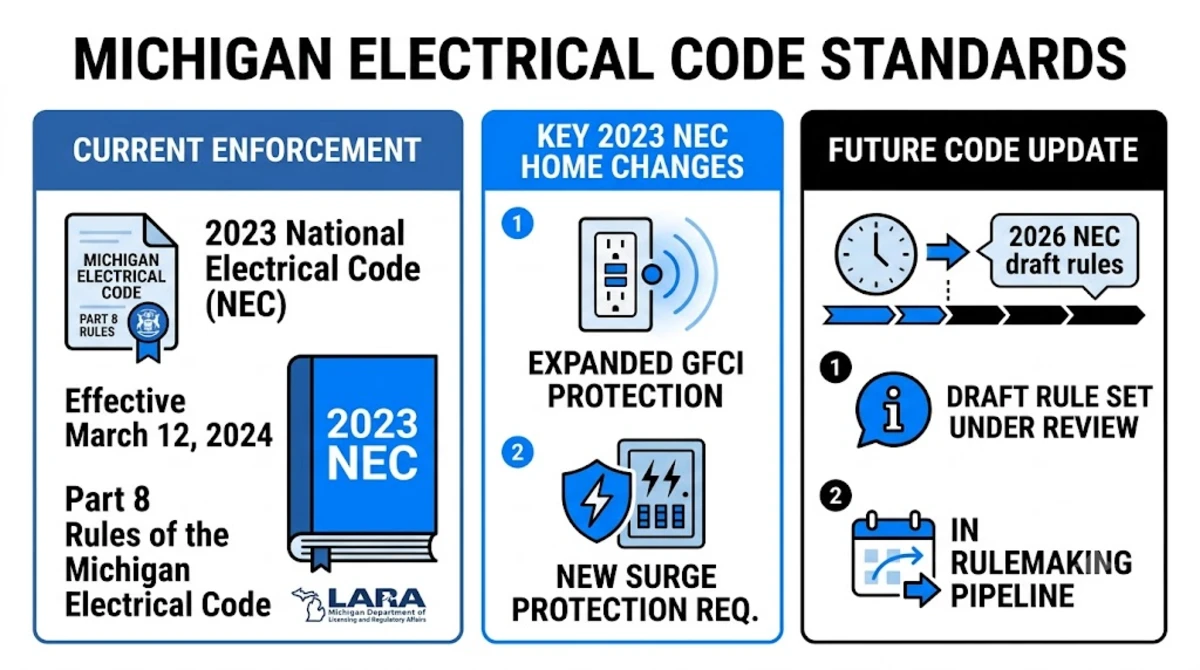
Michigan enforces the 2023 National Electrical Code through the Part 8 rules of the Michigan Electrical Code, effective March 12, 2024. The LARA Electrical Section administers that code where the state issues permits. The 2023 edition widened GFCI rules and added surge protection on new and replaced home services. Our GFCI vs AFCI guide explains the protection rules. A draft rule set would move Michigan to the 2026 edition, but it is not adopted yet.
One- and two-family homes add a wrinkle. The Michigan Residential Code has its own electrical chapters. Inspectors can differ on which one governs some details, such as arc-fault protection. For that reason, ask your permit office which edition and rules it applies to dwellings before you buy materials. A licensed contractor who works in your town usually knows the local reading already. That saves failed inspections and return trips, which is much of what a contractor’s permit know-how is worth.
Not sure your job needs a permit, or who should pull it?
Tell us the job and the address. IB Electric will confirm the permit office, quote the work with the permit included, and handle each inspection. Ask a licensed electrician or see our panel upgrade service.
Frequently Asked Questions
Do I need an electrical permit in Michigan?
Yes, you need an electrical permit in Michigan before installing, altering, or adding to wiring. That includes new circuits and outlets, panel and service work, EV chargers, generators, and rewiring. Many local departments treat a like-for-like switch, outlet, or fixture swap as minor repair, so confirm with your building department before skipping one.
Can a homeowner pull an electrical permit in Michigan?
Yes. Michigan lets homeowners pull an electrical permit for work they do themselves in a single-family home they own and live in, or will live in, plus its outbuildings. The exemption does not cover rentals, and you cannot pull a homeowner permit for a handyman or friend to use. You still must pass each inspection.
How much is an electrical permit in Michigan?
Electrical permit fees in Michigan are set locally. A typical single-family permit runs roughly $75 to $300. Many schedules start with a filing fee, around $15 in some towns. Then they add a base inspection fee and per-item charges. Larger jobs and plan reviews cost more.
How long does it take to get an electrical permit in Michigan?
Many local building departments issue residential electrical permits within a few days, and some same day. Where the state issues permits, you can apply online. State inspectors typically respond to an inspection request within two business days and inspect within five. Larger jobs needing plan review take longer.
Do I need a permit to replace an outlet or light fixture in Michigan?
Often not, if you are swapping a device or fixture in the same location with no new wiring. Many local departments treat that as minor repair. Adding a new outlet, fixture location, or circuit does need a permit. Because rules vary by enforcing agency, a quick call to your building department is the safest check.
What happens if wiring work is done without a permit in Michigan?
The permit office can require a late permit, an inspection, and fixes, sometimes after opening walls. Unpermitted work can also complicate insurance claims and home sales, because inspectors and buyers often ask for permit records. A licensed contractor can evaluate the work and permit any needed corrections.
Do I need an electrical permit for my project?
Probably, if the job adds or changes wiring. New circuits, panel upgrades, EV chargers, generators, and rewiring all need one. Who pulls it depends on who does the work: a licensed contractor, or you in your own owner-occupied single-family home. Where you file depends on whether your city runs its own program.
Who inspects wiring work in Michigan?
A Michigan electrical inspector from your local permit office inspects the work. Where no local program exists, a state inspector from LARA’s Bureau of Construction Codes does it. Inspectors check the rough wiring before it is covered and the finished installation at final. IB Electric books the inspections for every job it permits.
Conclusion
An electrical permit in Michigan protects the house long after the job is done, because it proves the wiring passed inspection. Three questions settle almost every case. What is the job? Who is doing the work? And which agency covers the address? If you are doing the work yourself in your own single-family home, you can pull the permit. If anyone else is doing it, a licensed contractor should pull it and book each inspection. Either way, the few dollars in fees buy a record that buyers, insurers, and future electricians will trust.
Ready to start a permitted electrical job?
IB Electric pulls the permit, does the work to code, and schedules every inspection across Wayne, Oakland, and Macomb counties. Book an assessment or call (313) 274-3588.
The questions to answer before you apply: the job, who does the work, the permit office, the fees, and the inspections to schedule.
Get the checklist →

